
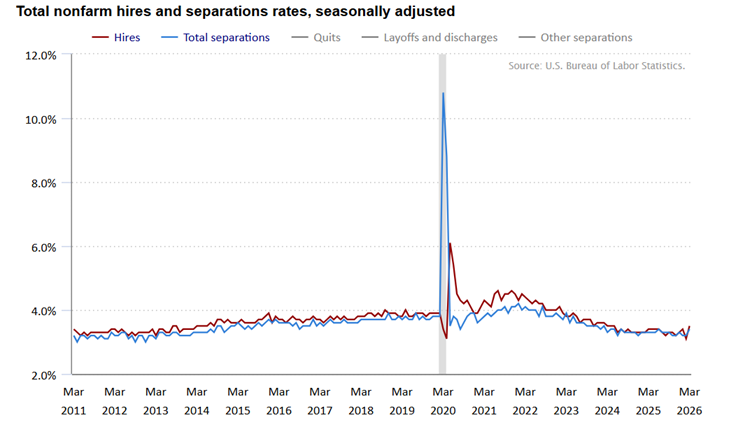
The latest U.S. payroll report offered another sign that the labor market continues to cool, but the slowdown still appears gradual rather than severe. According to the latest Employment Situation report from the U.S. Bureau of Labor Statistics, total nonfarm payroll employment increased by 115,000 jobs in April while the unemployment rate remained unchanged at 4.3%.
While job growth remained positive, the broader trend suggests hiring momentum has weakened considerably. The report noted that payroll growth has shown little net change over the past 12 months, which signals that businesses are becoming more cautious about expanding headcount. This does not suggest the labor market is in recession territory, but it does indicate that the exceptionally strong hiring environment seen over the last few years has clearly faded.
Healthcare remained one of the strongest areas of the labor market and continued to act as a major source of stability. The sector added 37,000 jobs in April, which was largely in line with its average monthly gain over the prior year. Growth was concentrated in nursing and residential care facilities, which added 15,000 jobs, and home healthcare services, which added another 11,000 positions. Demand for healthcare workers continues to benefit from long-term demographic trends, particularly an aging population that requires more medical services.
Transportation and warehousing also posted a strong monthly gain, adding 30,000 jobs in April. Much of that increase came from couriers and messengers, which added 38,000 jobs. However, the larger trend remains less encouraging because employment in the sector is still down by 105,000 jobs since reaching its peak in February 2025. This suggests that while April showed improvement, the broader logistics industry may still be adjusting to slower demand and post-pandemic normalization.
Retail trade added 22,000 jobs during the month, with hiring concentrated in warehouse clubs, supercenters, and general merchandise retailers. At the same time, department stores and electronics retailers continued to lose workers. This reflects a broader shift in consumer spending patterns as larger discount-focused retailers continue to outperform traditional retail formats.
Federal government employment remained a drag on overall payroll growth. The federal government lost another 9,000 jobs in April and total federal employment has now declined by 348,000 jobs since peaking in October 2024. These losses continue to weigh on headline payroll numbers and reflect ongoing weakness in public-sector hiring.
The information sector also remained under pressure, losing 13,000 jobs in April. Job losses were concentrated in telecommunications, motion picture and sound recording industries, and data processing services. The sector has now lost 342,000 jobs since its peak in November 2022, highlighting continued restructuring across technology and media industries.
Wage growth remained relatively stable. Average hourly earnings rose by 0.2% in April to $37.41, while wages increased 3.6% over the past year. This remains an important support for consumer spending, although policymakers at the Federal Reserve System will continue monitoring wage growth closely as they evaluate inflation risks.
The unemployment rate remained unchanged at 4.3%, and the total number of unemployed workers held steady at 7.4 million. However, some underlying indicators showed signs of weakness. The number of people unemployed for less than five weeks rose by 358,000, while the number of people working part time for economic reasons increased by 445,000. Labor force participation also remained subdued at 61.8%.
Taken together, the report suggests the labor market is continuing to slow in an orderly way. Hiring remains positive, unemployment is stable, and wages are still growing, but momentum is clearly weaker than it was a year ago. The labor market is no longer a major source of economic strength, but it has not yet become a major source of economic concern either.