U.S. markets delivered a classic rotation session on Thursday as investors moved aggressively out of technology and into healthcare, financials, and other value-oriented sectors. While the S&P 500 and Dow Jones Industrial Average finished comfortably higher, the Nasdaq lagged as AI-related enthusiasm cooled following disappointing guidance from Broadcom.
The S&P 500 gained 30.63 points, or 0.41%, to close at 7,584.31. The index traded as high as 7,598.19 during the session before settling lower into the close. Although the headline gain was modest, the composition of the rally was notably different from the AI-driven advances that have characterized much of 2026.
The Dow Jones Industrial Average led the major indices, surging 874.86 points, or 1.73%, to finish at a record high of 51,561.93. The rally was broad-based and heavily supported by healthcare and financial stocks. UnitedHealth climbed 5.36%, Goldman Sachs gained 4.98%, and Merck advanced 4.86%, helping drive the Dow’s strongest session in weeks.
Meanwhile, the Nasdaq Composite slipped 23.02 points, or 0.09%, to close at 26,830.96. The technology-heavy benchmark struggled as investors rotated away from some of the market’s most crowded growth trades. Broadcom was a notable drag, plunging 12.6% after its AI-chip revenue forecast failed to meet elevated Wall Street expectations.
Beneath the surface sellers are still active
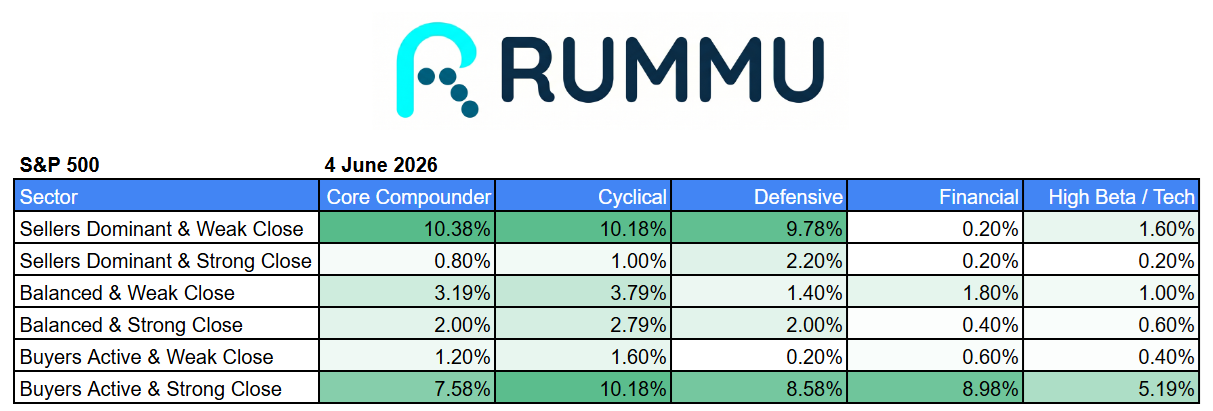
RUMMU’s intraday market behavior data revealed an interesting contrast between the major index performance and underlying stock activity.
Across Core Compounders, Cyclicals and Defensive sectors, roughly 10% of constituents finished in the “Sellers Dominant & Weak Close” category. At the same time, buyers remained active, particularly within Cyclicals and Financials, where nearly 10% of stocks ended the session in the “Buyers Active & Strong Close” category.
This suggests the market was not experiencing broad risk-off selling. Instead, investors were actively reallocating capital from one group of stocks into another.
Financials stood out as the strongest area of the market from an intraday perspective. Only 0.2% of financial stocks finished with seller-dominated weak closes, while nearly 9% closed with strong buyer participation. This aligns closely with the gains seen in Goldman Sachs and other financial institutions during the session.
Rotation, Not Weakness
The most important takeaway from Thursday’s session is that weakness in technology did not translate into weakness across the broader market.
For much of the past year, investors have treated AI and semiconductor stocks as the primary source of market leadership. Broadcom’s sharp decline served as a reminder that expectations within the sector have become exceptionally high. Even strong businesses can disappoint when forecasts fail to exceed investor expectations.
However, the market’s response was encouraging for overall market health.
Rather than triggering widespread selling, capital flowed into healthcare, financials, industrials and defensive sectors. This broadening of participation is often viewed positively because it reduces dependence on a narrow group of technology leaders.
Markets remain near record highs, but Thursday’s session highlighted a potentially important shift in leadership.
The Dow’s record close and the strength in healthcare and financial stocks suggest investors may be becoming more selective within technology while seeking opportunities elsewhere in the market. The ability of the S&P 500 to post gains despite weakness in several major technology names demonstrates that market breadth may be improving beneath the surface.
For now, the message from investors appears clear: AI remains a powerful long-term theme, but valuation and expectations still matter. As capital rotates into previously overlooked sectors, market leadership may become more diversified heading into the second half of 2026.
While the Nasdaq paused, the broader market continued to advance, a sign that this bull market may be evolving rather than ending.