
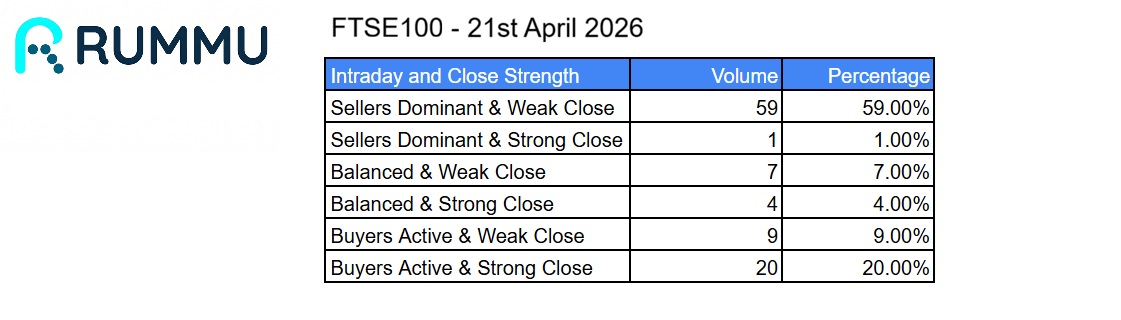
The FTSE 100 saw a notable shift in tone yesterday, closing at 10,498.09, down 1.05% on the day. This marked the index’s largest single-day decline since 26th March, signalling a meaningful pickup in downside pressure after a relatively stable period.
Beneath the surface, market internals confirm that this was not a random move, but a session firmly driven by sellers. A dominant 59% of constituents were classified as “sellers dominant with a weak close,” highlighting sustained intraday selling that persisted into the close. This type of structure typically reflects a directional downtrend day rather than range-bound weakness.
However, while sellers clearly controlled the session, the market stopped short of full capitulation. Around 20% of stocks still registered “buyers active with a strong close,” indicating that pockets of demand remained present. This suggests that while the broader tape was under pressure, buyers were selectively stepping in, preventing a more disorderly decline.
The relatively low proportion of “balanced” outcomes further reinforces the directional nature of the session. With only 7% of stocks showing balanced weak closes and 4% balanced strong closes, the market lacked indecision and instead leaned decisively toward selling pressure.
From a structural perspective, this points to a classic distribution day for the FTSE 100. Sellers maintained control throughout, but the presence of some late-stage buying suggests that institutional participants may be absorbing supply rather than exiting aggressively.
Macro conditions likely played a key role in shaping this behaviour. Ongoing uncertainty surrounding the Iran ceasefire continues to inject caution into global markets, with mixed signals around its durability keeping investors on edge. For a globally exposed index like the FTSE 100, this uncertainty is particularly relevant given its sensitivity to energy prices, commodities, and geopolitical developments.
Notably, the day’s largest declines were concentrated in aerospace and defense names, including Rolls-Royce, Melrose, and BAE Systems. This suggests a degree of profit-taking and de-risking within sectors that have recently benefited from elevated geopolitical tensions, reinforcing the view that markets are recalibrating rather than rotating decisively.
This backdrop helps explain the absence of strong leadership within the index. Rather than a clean rotation into defensives or a broad risk-off unwind, the market exhibited a more fragmented response, consistent with a cautious and headline-driven environment.
In the near term, the FTSE 100 appears to be entering a more fragile phase. The combination of a strong seller-dominated session and elevated macro uncertainty suggests that further volatility is likely. Should buyer participation weaken further, the risk of a more sustained downside move increases. For now, however, the presence of selective demand implies that the market remains under pressure, but not yet in a state of panic.
FTSE100 winners:

FTSE100 losers:
