
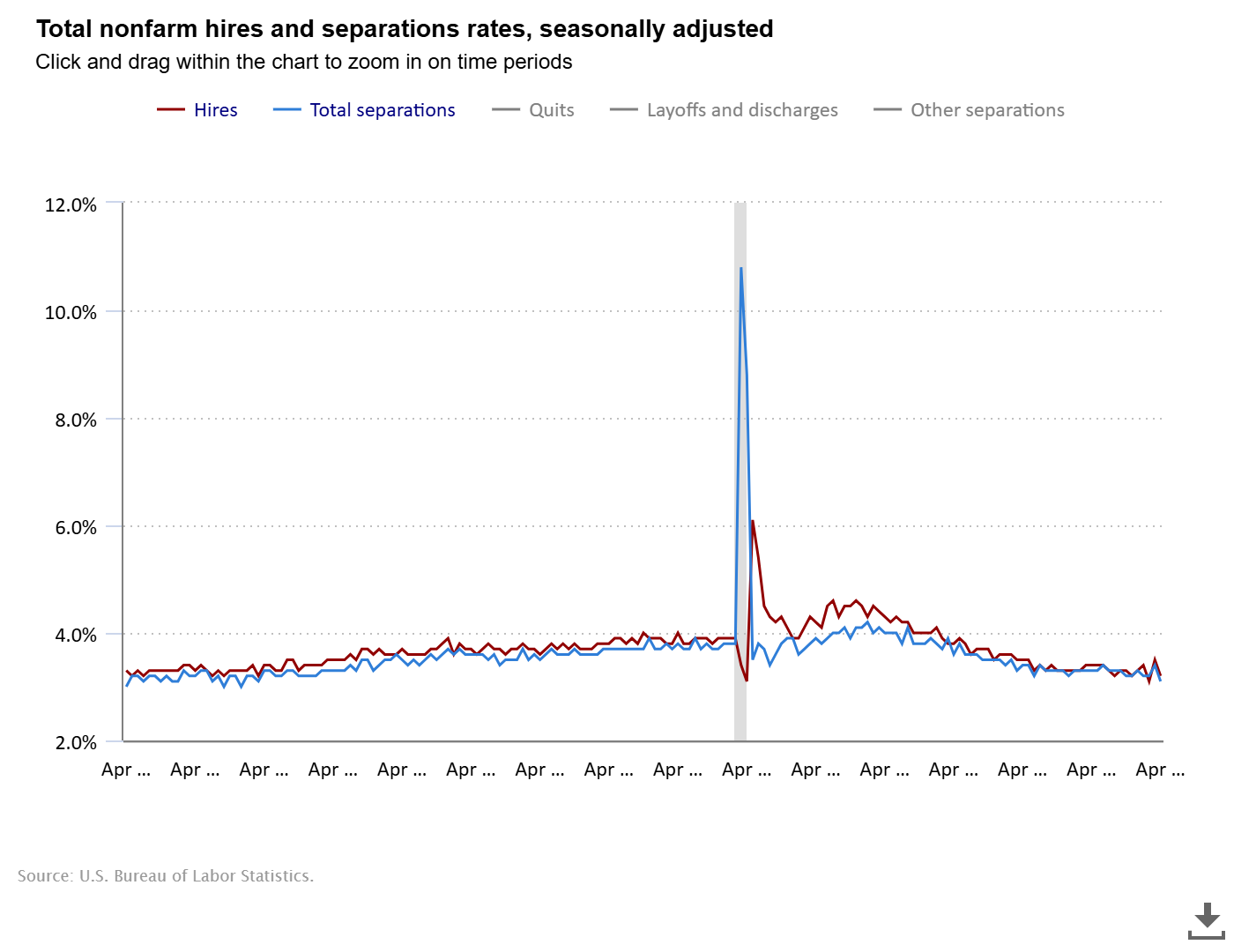
The U.S. labor market continued to demonstrate resilience in May, with employers adding 172,000 jobs while the unemployment rate remained unchanged at 4.3%. Although economic growth has slowed from the rapid pace seen earlier in the expansion, the latest employment report suggests that the labor market remains stable rather than deteriorating, reinforcing the view that the U.S. economy is navigating a gradual cooling rather than a sharp downturn.
Total nonfarm payrolls increased by 172,000 during the month, slightly below the pace seen in recent years but broadly consistent with April’s revised gain of 179,000 jobs. More importantly, revisions to prior months added a combined 93,000 jobs to March and April payrolls, indicating that labor demand has been stronger than previously reported.
Taken together, the latest figures suggest that employers remain willing to hire despite elevated interest rates, geopolitical uncertainty, and slowing economic momentum.
The unemployment rate held steady at 4.3%, where it has remained within a narrow range of 4.3% to 4.5% since July 2025. The number of unemployed individuals was largely unchanged at 7.3 million. Stability in the unemployment rate is particularly notable given the Federal Reserve’s efforts to cool inflation through tighter monetary policy. Historically, labor markets often weaken significantly during periods of elevated interest rates, yet the current cycle continues to show remarkable resilience.
Beneath the headline figures, the composition of job growth provides insight into where economic strength currently resides.
Leisure and hospitality led hiring in May, adding 70,000 jobs. The sector’s growth was substantially above its average pace over the prior year and was driven primarily by food services and drinking establishments, which added 48,000 positions. The strong increase suggests consumers continue spending on travel, dining, and experiences despite ongoing concerns about inflation and household budgets.
Local government employment also provided an unexpected boost, increasing by 55,000 jobs. Most of the gains occurred outside of education-related roles, indicating continued hiring across municipal services and local government operations.
Health care remained one of the most consistent contributors to employment growth, adding 35,000 jobs during the month. Ambulatory health care services accounted for the majority of the increase, while hospitals continued to expand payrolls as demand for medical services remained strong. Health care has now become one of the most reliable sources of job creation in the U.S. economy, benefiting from demographic trends and persistent labor shortages.
Social assistance employment also continued its steady expansion, adding 12,000 jobs during May. Together, health care and social assistance once again highlighted the defensive nature of service-oriented sectors that continue to generate employment regardless of broader economic conditions.
Not every sector shared in the gains.
Financial activities lost 22,000 jobs during the month and have now shed more than 100,000 positions since peaking in May 2025. Job losses were concentrated in insurance carriers and banking, suggesting that higher interest rates, slowing loan demand, and industry consolidation continue to weigh on employment within the financial sector.
Transportation and warehousing also remain an area of concern. Employment was largely unchanged in May but remains significantly below its 2025 peak. The weakness reflects a normalization following the logistics boom that accompanied pandemic-era supply chain disruptions and elevated e-commerce demand.
One of the more encouraging aspects of the report was wage growth.
Average hourly earnings increased by 0.3% during May and were up 3.4% compared with a year earlier. While wage growth remains healthy, it continues to moderate from the elevated levels seen during the post-pandemic labor shortage. For policymakers, this represents a positive development. Wage growth is still supporting household income and consumer spending, but it is no longer accelerating at a pace likely to create significant inflationary pressure.
The labor force participation rate remained unchanged at 61.8%, while the employment-population ratio held at 59.2%. These measures suggest that the supply side of the labor market remains largely stable, with neither significant improvement nor deterioration occurring during the month.
There are, however, signs that the labor market is becoming somewhat less dynamic beneath the surface.
The number of long-term unemployed individuals remained near 2 million and has increased by more than 500,000 over the past year. Long-term unemployment now accounts for 27.5% of all unemployed workers, indicating that while hiring remains healthy overall, some displaced workers are taking longer to re-enter the workforce.
Similarly, the number of individuals outside the labor force who want a job remains elevated at 6.2 million. While these figures have not worsened significantly, they suggest that labor market conditions are not as universally strong as the headline payroll numbers might imply.
For investors, the report likely strikes a favorable balance.
Job growth remains strong enough to alleviate concerns about an imminent recession, while wage growth continues to cool gradually. The combination supports the narrative of a labor market that is slowing in an orderly fashion rather than breaking down. Such an outcome could provide policymakers with greater flexibility as they evaluate future interest rate decisions.
The broader picture emerging from the May employment report is one of moderation rather than weakness. Hiring remains healthy, unemployment remains low, wage growth is positive, and prior payroll gains were stronger than initially estimated. While certain sectors such as financial services and transportation continue to face pressure, the overall labor market continues to provide a solid foundation for economic growth.
After several years of extraordinary volatility, the U.S. labor market increasingly appears to be settling into a more sustainable equilibrium. For now, that remains one of the strongest arguments supporting the economy’s continued resilience.